Wednesday, June 30, 2004

Not a Photo-Blog

This is not a photoblog, I promise. I am still planning on writing more entries and having more things to say here, but as I am busy working on projects for school, I figured that taking about ten minutes to make another post would not hurt anything. I need a bit of a mental rest. I also figured that I need to let the blog readers know that I haven't disappeared somewhere into the aether known as cyberspace.


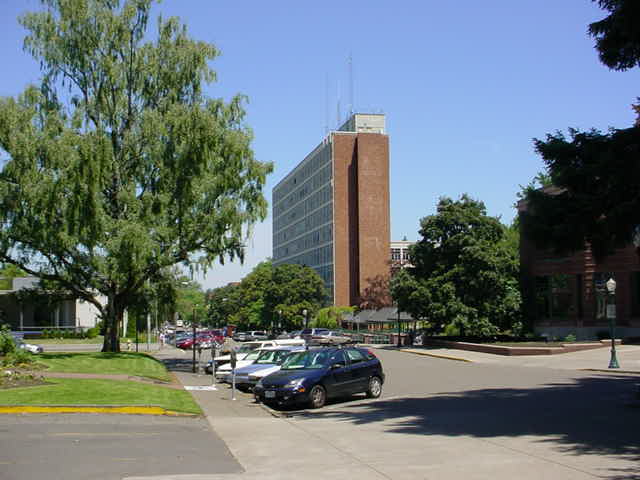
My Building! Posted by Hello


My Desk! Posted by Hello

The first picture is of the building where I spend the majority of my time away from home. In fact, this is pretty much the view I have when I am walking from car in the parking lot behind me, towards the desk which is the focus of the second picture. My desk happens to be the one with the orange chair. If it doesn't look comfortable, that is because it isn't, but as I have said before, the office is a good place to work because it is relatively free from distractions and not nearly as crowded as the library. Until next time!

Friday, June 25, 2004

Work Continues

This is the real crunch time for me. Despite some personal problems, I really need to finish up the papers that have been dogging me for the last several days. According to a letter I just received, I may only have until the middle of August. Things may not be as bleak as I once thought, but they are definitely as serious. Nothing is really guaranteed. So, as work still continues, I figured I would post a picture of the place where I will be spending most of my time during the next several days: the library.


The Library Posted by Hello

The library is a decent enough place with some good places to study, although I prefer working in my office because there is usually less people. However, according to one of the professors here, the library is where all graduate students should live in order to do the research that is required of them. For undergraduates, he says that since they should learn how to love reading, their time should be spent in a comfortable chair or study space. If I had to do graduate school all over again from the beginning, I would do so many things differently. But things being as they are, I suppose that the only thing to do is to immerse myself in work and stay immersed until it is done, even if I feel like I am drowning.

Wednesday, June 16, 2004

Another Quick Post

According to blogger, it has been about 12 days since my last post, so I figured I would take a quick break from work to post this picture of the office plants. None of them are mine, although I was bequeathed an African Violet by an officemate who is leaving to teach Folklore in Iowa. I think that the ivy plant would look better hung up along the edges of the wall, but because this office gets very little light in the corners, it would probably condemn the plant to death.


The office plants! Posted by Hello

I've got some other pictures that I've taken recently around campus that I will eventually put on the web, but for the time being, this is it. Until next time, which if I don't get caught up on this work soon, could be awhile.

Friday, June 04, 2004

Notes for my Seminar Paper

Partially because I have not posted here in awhile, and partially because my research notes are a little spread out while I have been frantically trying to finish up my Spring term here at the University, I am going to post some brief notes about the seminar paper for my figures class. I know I can always find them here, a place where they won't be lost. Also, I need to translate them from the hurried notes I made in paper during my earlier meeting with the professor into actual print before the float away back into the ether of unremembered thoughts.
Kenneth Burke, a rhetorician(?), talks about four master tropes: metaphor, metonymy, synecdoche, and irony. He does not create a new typology of figures like past rhetoricians (Cicero, Longinus, Puttenham) because he feels that every figure, which could have potentially infinite separate names, spring from these four basic types. There seems to be some kind of correlation, if a distant one, to Giambattista Vico who had postulated that, before early humans had language, there were four major mental figures that were the foundation of the rest of the figures commonly identified. Whereas Vico seems to be doing some kind of anthropology through the study of figures, I think Burke avoids theorizing about language origins the way Vico does.

In any event, broadly speaking Metaphor identifies one thing for another (A=B), Metonymy has one thing that is part of a whole ( B (A)), Synecdoche has one thing result from another (A --> B), and Irony has one thing that does not equal the other (A =/= B).

After talking with the professor about my idea, which has to do with hyperlinking, he suggests that I should get at Burke's purposes for proposing these four tropes. I should tell why these four tropes are something that is useful--the "correspondences in drawing out those tropes and larger issues. Specifically, I should address "perspective, reduction, representation, and dialectics." I should "talk about these four substitutions, which represents different perspectives from which to work.

As for myself, is there anything I can do with 1337 speak? Can I do anything with the forms of certain websites, especially blogs themselves. This might have to be looked into and thought about more. Is there something about RSS feeds, or a general kind of aggregation?
The Professor, (aka Dr. Brown Shoes), recommended that I review the essays that were presented in class very carefully, offering his caveat that I Burkian study can be particular hard. Yet, I am hoping that my rudimentary knowledge of the Net will help all this study go more easily; think "spoonful of sugar." Now, I am going to check out the required Burke books, after a little more research into the appropriate journal articles. Just as a friendly note, this might be the last blog for a week or more; the seminar papers will always take precedence.

Sunday, May 30, 2004

Another Picture

This not much a post really. I took the photo you see a couple of weeks ago, but I have only just now got it uploaded on to my laptop. As the caption says, it is picture from the fourth floor of my office, a dank little dungeon like cave that I share with six other people. Trust me, it is not even as glamorous as I just described it. However, it is an office, and as such, a nice place to do some homewrok and grade some papers without being disturbed too much.


This is the view from my fourth floor office! Posted by Hello

Lord help anyone who tries to study in the library. Even though everyone whispers, it is just too crowded during the middle of the day. Anyway, the two large victorian type buildings in the back are a ocuple of Greek houses, and the low squat building close to the front right are the local university slums, aka quads. Oh, and parking here is terrible. If you're not at school insanely early in the morning, you may as well go home and walk to school, because you're sure not going to find any parking, and it will likely take the same amount of time.

Patusan and the South Pacific

Okay I have read the rest of the book (Lord Jim), and the events are a little more clear now. First, I should say that Jim did not go to trial separate from the other crew. The German captain was also tried and found guilty. The consequences of their actions resulted in the loss of the licenses that allows them to be merchant marine officers. Therefore, Jim is not distinguished from the other crew members. The narrator, Charlie Marlow, concerns himself primarily with Jim's character because he wants to solve "the problem" of Jim's character and find out what makes him think the way he does. The question is important for Marlow because he frequently mentions how Jim was "one of us." Here is my best summation, and interpretation of what happens next:
Jim, devastated by the loss of his license, and the knowledge that he acted cowardly in the Patna incident, take various jobs working on behalf of shipping companies. However, he only works at these jobs until the point people discover his involvement in the Patna episode, upon which he leaves for another port to find another job. These series of exiles continue until, ironically, everyone seems to know about his past making it impossible to run away from it anymore.

At this point, Marlow intervenes and finds Jim a job with shipping company run by a mysterious man named Stein. Stein appoints Jim to a post on the Island of Patusan, an island inhabited by the previous company representative, a Portuguese man named Cornelius, and the native inhabitants--South Pacific Islanders who, thanks to an Arab foreigner, are apparently all Muslim. Jim distinguishes himself to such an extent that he becomes the virtual King of the Island. He, with the blessing of a particular chief, makes war on the other villages and succeeds in uniting the Island under his rule. As one of the only white men on the Island, Jim attains a mythic, almost God-like status among the villagers. And of course, Cornelius has a daughter that falls in love with Jim, so Jim takes her for his native wife. Jim names her Jewel.

Jim, living in this Island as a virtual King and God, seems to have escaped the humiliation of his past. Until, one day, when pirates show up and start killing people. The tribes turn to Jim for help, so Jim arranges for the pirates to leave without a fight through negotiation. But the pirates, jealous of Jim's power and stung at having been repulsed by mere villagers, seek revenge. Before they leave, the pirates attack a native outpost killing the chief's son. The chief, horrified and disconsolate, now knowing that Jim is not some kind of super-being, kills Jim as a kind of retribution. End of novel.
The implication throughout all of this is that Jim's basic problem is that he is a romantic. He persecutes himself over the Patna episode and exiles himself from Western Society. It is his sense of Romance that impels him to send the pirates away rather than kill them outright. And it is his sense of romance that leads him to face the chief at the end of the story, where he might know (I'm not sure) that he will be killed. Jewel accuses him of knowingly leaving her, and in a sense, he does.

The interesting connection here for me is the fact that the people he abandoned on the Patna and the people of Patusan are all Muslim. In the first instance, Jim left them to die what he assumed would be a certain death. In the second instance, he defends the Muslims against the whites and faces a death that he feels he should have faced on the Patna. This may be why Jim feels him must face the chief, rather than escape. It is romantic because he must think it courageous to face death, especially over an issue of honor: he must think it is honorable to account for his role in the chief's loss.

Of course, it should be remembered that throughout this novel are most of the 19th century prejudiced assumptions about race combined with their belief in the inherent superiority of white western peoples. For me, that Jim becomes a local god among the natives smacks of the insidious paternalism that is one of the disgusting features of racism; this kind of thinking goes along the lines of, "These people are such children. Obviously, they need my help." Of course, while the novel, or Marlow as the narrator, may suggest that Jim is helping the natives acheive success until the moment the chief's son is killed, what Jim is really doing is using the native for his own purposes. He is absolving himself of the guilt he feels. Like Ophelia says, he is no hero.

Saturday, May 29, 2004

The Patna

I'm halfway through Lord Jim, Joseph Conrad's ambiguous novel about the exploits of Jim, a sailor experiencing shame and remorse for his actions aboard the Patna. I say ambiguous because it is rather uncertain what he has done to feel so ashamed about. Here's what I think I know so far:

Jim is a mate on the ship Patna, transporting approximately 800 Muslim pilgrims to Mecca. While in the red sea, they hear a bang, and Jim investigates. He finds a large bulge in the bulk head an immediately knows that the ship is going to sink. What's more, he knows that they do not have nearly enough life boats for the amount of people currently on board. The "white" crew members, including the German captain, scramble to release the life boats without the pilgrims waking up. Jim, who has delusions about being a hero, jumps into one of the lifeboats, but he is taking the place of another white man who has already had a heart-attack, and so is dead, but Jim doesn't know this.
(I'm not sure why it is wrong for him to jump in the lifeboat with other crew, aside from the fact he is leaving 800 people to die on the ship, but then so is the rest of the crew. The reason it appears to be bad is because he took the other man's place.)
Suddenly, a storm comes upon them, and the frantic scrambling to get off the boat becomes more frantic because the crew, Jim especially, knows that a swell will sink the boat for sure. However, even though the white crew members see the lights go out on the ship and tell themselves that the Patna has sunk, a French ship comes upon the boat and tugs it to harbor. Jim faces trial for some reason.

However, why Jim faces trial separate from the other men is a little confusing to me. From what I understand, the other crew is just a guilty as he is. If it is because he took another man's place in the life boat because he was scared, I don't see why he should face trial for that. The real trial seems to be in Jim's own mind. He, rather than being a hero, convicts himself of being a coward because he thought of himself first, and did not do anything to prevent what he assumed would be the assured death of 800 human beings. I'll finish the rest of the book tonight. However, if anyone has any comments or opinions that would clarify this situation, I'd greatly appreciate it.

Monday, May 24, 2004

Recovery

Yesterday afternoon, the police called to say that they found my car. They asked if I could meet them where my car was found in fifteen minutes. They said that I would be able to avoid the towing fees that would be applied for an impound if I could be there quickly. The previous night, I had spent about an hour regretting the loss of my car and wondering if there was anything I could have done. I no longer wished for vengeance like I had in the previous post. I didn't want to drive a loaner car. And I didn't want to have deal with the increased insurance fees that certainly accrue. I simply missed my car.

My heart jolted hearing that it had been found. Since I was already working on the computer and was already on the internet, I surfed over to Yahoo Maps and found the address that the cops indicated where I would find my car. It was less than three blocks away in the parking lot of another apartment complex. When I got there, there were two cop cars and four officers standing around laughing about something. I approached them.

One of the officers was the same guy who took the initial report on Friday morning, Officer G-----. Officer G----- asked me if the car sitting in the corner of the lot was mine. There it was. It was in the furthest lot away from the road, completely out of sight behind a fenced-in garbage bin. Another car parked next to it had the passenger side window broken out of it and covered with plastic. I identified my car for Officer G----- and inspected the inside of it. Although the inside of the car was a mess, the result of the thieves searching for something of value (and not finding anything), nothing appeared to have been stolen or damaged. Even the change in the ashtray remained. "What'd I tell you," officer G---- smiled, "I knew we'd find it intact." He was also right about it still being in the neighborhood. He said that on Friday when he took the report.

When the other cop car pulled away, and me and Officer G----- went over to his car to fill out another evidence report. I asked him if he knew who took it. He said that he didn't. I signed the report, a copy of which he gave me this time, started my car, and left. About an hour and a half later, feeling curious, I returned to lot to inspect the apartment buildings surrounding the area. I saw that there was still a police car in the lot. Maybe the thieves were still around. Not wanting to get too much more involved, I left--this time for good.

I spent about a half hour driving my car and wondering what I should do next. My girlfriend says that it really does not make much sense to invest in any security features because it is unlikely that the car will be stolen twice (relying, of course, on probability). Furthermore, any investment on my car should be applied towards making it run better. I'd really like to have a trunk monkey, but a nicely worded letter would get about as much return as anything else.

Dear Mr. Thief,
If you steal this car again, I will pee on your cornflakes and shave off your eyebrows. Don't think it won't happen. Me and the Dali Lama are surveilling this alleyway, and while I know kung fu, he can shoot lasers out of his eyeballs. Plus, he turns green when he's angry. You wouldn't like him when he's angry.

I guess I still feel pretty weird about the whole episode. It turned my weekend upside down, and now I realize that I'll always worry about my car being stolen. I also realize that there may never be any answers or explanations for why this has happened. I can speculate that it was one guy or two, that it was fraternity prank, or desperate action of a hungry, homeless man. I can waste time guessing, but I have to admit that I may never know who did it or why. As I have already called my insurance company, there'll be more on this situation later.

Friday, May 21, 2004

Stolen!

Last night, sometime between 6:00 p.m. and 7:00 a.m., my car was stolen. It's rather hard to believe that someone wants a fifteen year old car that runs like a lawnmower in a rock quarry, but there it is--or isn't I guess I should say. (According to this website, my make of car is the third most frequently stolen, and so is the year, and the color. Third place all around! Here's fun, try a find if your car is on the list! Yay! I kind of wish I knew this beforehand.)

Initially, I was stunned and stood stupidly looking for it in the gravel lot where it had been parked. Although I feel I am a rational person, I had to admit that I felt some initial self-doubt. Could I really trust myself that I had parked where I said I did? Did I drive home yesterday, or did I take the bus? Slowly, the details came back to me. No, I remember checking to make sure that I locked it, even circling the car to check the doors.

When I called the police, I said: "I can't find my car." The shock had not yet sunk in. They, being used to the bad behaviour of individuals, quickly helped me realize that it was stolen, and not merely missing or inadvertantly towed. Apparently, there's a State (or city?) database that tracks all of the tows that had been made within a certain period. If it had been towed, then they would know. My car was not on that list.

They said they were sending an officer over to talk to me. It took forever for the cops to show up, like they always do when you've been the victim or witness to something like this. While I waited, I tried shutting out the rest of the world so I could grasp the reality of my stolen car. It was hard for me to concentrate on other things. Consequently, I needed to go back inside my apartment and sit on the couch.

When the cop arrived, he introduced himself and asked if he could have a seat. "How are you doing today, sir?" he said. "I've had better days" was my depressed reply. He sat at the kitchen table and began filling out a form (a police report?) that was on goldenrod paper. I gave him my identifying information and my driver's license. He asked: "Does anyone have permission to drive your car?" Immediately, I thought of a COPs show scenario where they have pulled over some guy in stolen car who is mildly complaining that he was a "friend" of mine and I gave him permission to drive the car. He asked me if there was anything distinguishing about the car, and I told him that I couldn't think of anything off-hand. (I should have said something like: "Distinguishing how? You mean other than the fact that it is fifteen-year-old piece of crap?")

He asked me for the VIN#; I couldn't find my title, and the theif, of course, had my registration. Fortunately, I dug up my insurance policy which had some information on it. I sat at the table and listened to the cop tell me stories about how they almost always recover the car. This was heartening. "I personally," he said, "found twenty four cars myself. There was a car stolen from a lot near here that we found just recently." I asked him how long he thought it might take to find my car. It seemed a reasonably, if overly hopeful, question to ask at the time. He said, "You can't tell. I could drive out of here right now and find it in five minutes." He said that many times theives don't drive the ill-gotten cars very far, perhaps only a few miles or just a few blocks.

After more clear-headed reflection, I realized that I unconsciously supposed that the cop was going to automatically fix the situation and that my car would magically return by his very presence. I wanted, needed, to believe him about recovering the cars--and partially, I did. Of course after he left, I realized that he did not leave a copy of the police report, nor did he leave a business card. Hell, I didn't even know his name. I took this as evidence of the fact that such happenings are routine for him, and his offered assurances were perhaps more mechanical than genuine.

And then, once the cop was gone, I was left with the decision about what I should do for the rest of the day. Obviously, I was going to have to call my insurance company and make some kind of claim. And obviously, I was going to have to call the Police department for the police report. Once I had time to think more clearly, I recognized that there were a lot of others things I could have told the cop about my car--there are scratches on the windshield from the time I tried to shovel snow off the front it with a broken shovel, there are student parking stickers on the bumper, there are (as my girlfriend reminded me) a couple of ancient and petrified french fries underneath the seats. My decision was that I was going to do what I originally planned on doing. There's nothing else I really could do.

I'm still angry about this (although not as strongly as this morning when I first discovered my car was gone.) I should have the right to park in any legal space. Hell, I should have the right to park in an illegal space with the expectation that I'll be fined heavily and towed, but that my car will not be stolen. Although not much money to some, I paid about $6000 dollars for that car. I spent countless hours working at a job I hate to get it.

Briefly, I had a contradictory feelings: I want to get my car back, and I somehow want my car to rise up against them. Will the steering go out at a critical moment, or perhaps the brakes will stop working. If they use as a getaway car for a crime, perhaps the car will not start when they are trying to effect an escape. Mostly, I suppose I really want justice. I want whoever did this to stand trial, and if proven guilty, to go to jail. I want them to feel bad about taking something that wasn't theirs. So far, I've decided to take meager consolation from the fact that along with my car, they've also stolen a couple of ancient french fries and an empty McDonald's bag. It's not much, but it's the only thing I've got at the moment.
Thursday, May 13, 2004

The Tables have Turned

I suppose that I have no right to complain. After all, this is probably just a taste of my own medicine. What the heck am I talking about? Keep reading.

Not many people know that I have had to take incompletes for the first courses I took in graduate school. It wasn't something that I sought out, but rather a necessary consequence of the difficult adjustments that I was undergoing during that time. I know that I have a tendency to lament the amount of work that I typically have to do for school. However, the first term really was a bit of a shock. Fortunately, I was able to finish up one of the incompletes last term. Now, there is only one other left.

But, time is getting short. I absolutely must have this incomplete resolved in the next three weeks. Add to this project, which is a full-blown seminar paper, I have two other seminar papers due within the same time frame--papers that will require a staggering amount of research and work in the next couple of weeks.

So what about today? Today, I was to receive the rough draft of my seminar paper for the course that is still incomplete. However, when I met with him during his assigned office hours, the professor admitted to me that he did not have it done. Despite his promise to read it, despite his assurances that he would have it ready for me last week, despite our other conversations about how necessary it is for me to finish this up--he did not have it done. He said that it was still sitting on his desk at home.

His explanation was that his wife has just recently had a baby within the last two months and that he has been busy assisting with the kid. It is very easy to see that he is a happy father, a proverbial "proud papa." I understand this. I have turned in too many late papers to frustrated professors not to know how life can sometimes reach up and smack you in the face sometimes.

And yet, it is hard not to feel increasingly apprehensive about the prospect of getting this paper completed in the next couple of weeks. I sincerely hope he follows through with his promise to conduct an e-mail appointment with me over the weekend. If not, I'm afraid I'll have find out where he lives and call him at home. Not quite the proper protocol for a grad student, but, hey--I'm getting desperate here.

Wednesday, May 12, 2004

1000 words

In a move that will probably be unnoticed by anyone except a handful, I finally figured out how to post pictures to my blog. It has been over a year, but it's done. And I really couldn't be happier. Of course, this means that I will have to start taking some pictures, and do to that, I need to get my hands on a digital camera. I'm still a word nerd at heart, so don't expect too much in the photograph department, especially for now. However, once I get the expendable income and the expendable time, I plan on playing around with this new picture ability for some time. Bless you Blogger.


Photographs are here! Now, I can get funky!
Posted by Hello

By the way, while I'm here, if you can please take the time to answer the poll at the bottom right hand side of this page, I would be much obliged. There are some new templates that are awfully attractive. I've also discovered that while I use a handful of links in the columns a lot, some of the information appears to be redundant. That is, unless of course, you guys think that it has some value. In any event, if I do change the template, I'd probably keep most of the side stuff anyway. We'll see. But, please, if you see this, please vote. Thanks in advance.

Lessons and Lessened

The internet is not just a place for e-mail, instant message, news, or culture. It has it dark places too--the least of which, but probably the most familiar, is the presence is pornography. It is these other places that I worry about most. Adults, who take seriously the ability to think critically and be responsible members of society, absolutely must decide what they stand for, so they can make decisions about their own morality.

One of the darker sides of the Internet revealed itself with the web broadcasting on Tuesday of the horrific killing of an American contractor in Baghdad. Although I am consciously, and very deliberatively, abstaining from the too-often-poisonous political rhetoric that infects public discussion of the war, I feel I must add my voice to the others who have near-universally condemned this barbarity. No-one, regardless of politics, or even previous atrocities, should have to die this way. The torture (not abuse) of Iraqi soldiers is reprehensible, but so is the killing of hostages. The colloquialism holds up: two wrongs do not make a right.

What has perturbed me today are the various sites--sites which I will not even refer to in the slightest way--that are mirroring the graphic video. While surfing on a particular site and reading the usual political commentary surrounding this tragic event, I was shocked to discover that people, primarily young men, have rooted out the footage and are seeing for themselves. And there are more than a few places that are hosting this, for lack of a better word, satanic video.

Aside from a few individuals infected by a diseased love for violence, there are some people who argue that the footage needs to be seen, that we must be a witness to happens in war, so once everyone is sickened by these atrocities, society will change for the better.

I disagree.

While it is sometimes necessary to be a witness to violent acts--such as the brutal effects of war on society, famines caused by greed or embargoes, or genocidal acts like the Killing Fields in Cambodia, Germany, and Rwanda--it is not necessary to see these kind of acts for the healing light of public exposure to root out the perpetrators of such acts, and so that justice can be fair but not willfully ignorant or blind.

Justice should be the primary motivating purpose here. Was it justice for the allies in World War Two to reveal the previously hidden genocide against the Jews, which was perpetrated by the Nazis? Did we need to expose the brutality of those acts to a disbelieving global public? Yes, I believe it was. Would it serve justice to see this footage of the American’s death? No, I do not believe it would be.

I will not see the video now or ever.

I am making a choice based on my own sense of morality, which is derived from my own sense of justice. This is precisely what I am arguing everyone on the Internet must do, right now. You don’t want to be the person who stumbles into one of these dark corners of the Internet and see this video, piqued by your curiosity, not thinking of the consequences. There are some things that you can not un-see. Take seriously the words of an individual who, by his own confession in the public comments of the site I mentioned, has watched it: “I am lessened for having seen it.”

Monday, May 10, 2004

Rain and Architecture

Rain. Nothing but rain all day, but it fits my mood lately. After class today, I intended to turn in some paperwork to the administration building. But once at the front counter, after a ten minute walk across campus, I discovered that I forgot the paperwork I needed, which was still on my desk. I had accidently left it there this morning. Consequently, I ate a brief, and unhealthy, lunch on that side of town.

As it was raining hard, drenching the grimy sidewalks and flooding the barkdust surrounding the school's decorative irises, when it came time to walk back, I decided I would make my way through the other buildings. Normally, I would have stuck the sidewalks. I wish I had the expendable income for a decent digital camera and a reliable image host because I would post my impressions of the walk on this blog--perhaps one day. I discovered that I work in probably the most ugly building on campus. Some of the entry ways of these other buildings are truly beautiful, and most have an inner courtyard that looks really inviting. Also, there is a character in the older buildings that is entirely missing from the 60's disaster where I am currently ensconced.

Now, I am stationed in my office where I will spend the better part of the evening. With the exception of meeting some English 104 students who are unhappy with their grades, most of what I have planned for tonight is reading and grading mid-terms from the aforementioned class. But to prevent dullness of spirit and my eyes from glazing over, I think I will take another walk before it gets dark. Probably around dinner-time.

Friday, May 07, 2004

Re-visions and Returns

More than ten years ago, I worked at a factory that made printed circuit boards. The quick summary on that long story is I hated it, but didn't think that I had much opportunity to do anything else. I now consider it my first introduction to how the class system works in this country, but back then I saw it as a certain type of fate. The one good memory that I have of the place is when me and few of my coworkers, also working-class grunts, went out in the parking lot at two a.m. to get a good look at comet hyakutake. It was bright, the tail was long, the break from the horrendous work we were doing was refreshing, and the fact that the comet shone against the stars over a darkened field of tall grasses and weeds made the experience memorable.

But, as I mentioned before, the work was terrible. Twelve hour days, low pay, and frequent exposure to harsh chemicals and the occasional x-ray, which is above and beyond the petty office politics that must occur in every job, was an angle grinder on my soul. The prospect of it continuing felt like a condemnation. To adopt the discourse of recovery, I "had a moment of clarity" when I was hanging half out of chemical etcher scraping out the organic residue that grew like a grimy ring in a bathtub. The hydrochloric acid seeped into my gloves and stung my skin, the gas mask made it hot and difficult to breath and also cut into my neck. And being on my knees for about an hour, half bent over the lip of the machine made my back stiff. My earlier fantasies of going to college returned with the force of determination. Consequently, I enrolled at a local community college and began the path to where I currently am, a grad student with the goal of one day teaching college English and Literature courses.

The community college experience was almost one of religious conversion. Not only was it a tremendous contrast from the factory, but I soon found that it was truly something that I enjoyed doing. I discovered that my most enjoyable classes were the English and Writing courses. Going to the small buildings in the shade at the edge of the campus to take those courses was a genuine pleasure. I first read Hamlet, discovered my love of writing, and was able to approach language from the new perspective of having a voice, something to say. At work, no-one cared what I thought because I was hired to either be told what to do or tell others what to do. There was hardly a thing that I did not enjoy learning at the community college.

Several years later, I am a graduate student who may soon teach college writing courses rather than take them. But today--May 7th--I am actually back on the same campus. I walked around looking at how some things have changed and think about the past upon seeing the old rooms and buildings. Perhaps one day in the future, I may have the opportunity to teach here. I think it would be wonderful to give that back to the spirit of life, to be able to help other students who may be stuck in jobs or life circumstances that they hate, and help them discover their own talents, and somehow find within themselves an ability to pull themselves out of the compressing circles of misery.

I even happened to meet a friend and former classmate from my undergraduate university, G----. (I think I am going to adopt the 19th century Victorian mode of referring to people's names by the first letter.) G---- took a job here as a counselor, helping middle school and high school students see college as an option for them by taking them on tours of local unversity campuses. G---- and I caught each other up on what we had been doing since the year we last saw each other. In a weird way, G---- was impressed that I had gone to graduate school, and I was impressed that he had a job in an academic setting, especially a college that may want to teach at myself. I had always admired G---- for what I considered to be his moral integrity. Although much more has happened today, I suppose the lesson that I am going to take from it is that presents you with opportunities, and you, somehow, begin the process of sorting them out. Perhaps I still believe in fate, but I also believe that if you live your life with good intentions and effort at having some purity of heart, life will bless you in ways you don't expect. So while there may be fate, there are no "real" curses--not for those intentionally trying to do their best to be a good person.

Friday, April 23, 2004

School and Taxes

I've paid my taxes, and thank goodness that they're all done. Normally, I would have taken them to a tax preparer and said "take whatever money you want, just get the darn thing faraway from me." However, my girlfriend persuaded me that my former approach was ridiculously extravagant, especially since my taxes are ridiculously easy. Consequently, we used the turbotax program that she had on her computer. It still cost about 25$ to file electronically, but overall, turbotax was a relatively painless experience. Maybe next time around, I should buy the program myself and have it installed on my own computer. A basic Quicken program was something that came with my new laptop, and, I have to say, I really think it's a really handy program to have. As a person, who has a lot of hangups with money, I think I'm beginning to relax about it a little.

School continues as always and I'm still behind in work, but what else is new? On Tax day, I sat in the back of class to watch the instructor I TA for try desperately to capture the utterly bored students' attention. He wasn't succeeding. In fact, one of the students near where I was sitting was actually doing her own taxes during the lecture. I watched her looking up information in the tax tables, and presumably filling out the short form. I admit I was impressed that she seemed to both start and finish her taxes all within class time. It's kind of amazing what students will do when they're bored in a large class of 100 students. They don't think the professor can see, or really cares (which he probably doesn't). Close to where I usually sit, two guys normally have their laptops open, and one of the students this last time was developing a website, presumably for a project in his computer science class. English professors who are a certain age are the worst with technology. Half of the time, they're not sure how to get the lights in the classroom to turn on. Usually, when I enter the classroom, which is always five minutes before the professor, I make sure to turn them on and raise the projector screen. Otherwise, the professor would spend about ten minutes looking for the buttons and asking if everyone can see in the dark. Although, I guess I should stop, because judging from the students' interest, those ten minutes might be the only amusing thing in class.

Friday, April 02, 2004

Dinars for Sale

The other night me and my girlfriend were watching television and saw Iraqi bank notes for sale on a home shopping channel. These, apparently, are the old notes with Saddam Hussein's picture on them. (From a site that lists the bank notes of various countries.) Normally, I don't like to share my personal politics on the web, but I have to say that selling these things as mementos causes me feel a little uncomfortable.

On the one hand, I can understand the desire to have a personal connection to a historical event, or some other kind of personal experience that one wants to remember. After all, why does one take photographs of special occasions, or buy cheap souvenirs while on vacation if not to have a tangible reminder of something one wants to remember. My grandparents have kept a newspaper from 1969, the day astronauts landed on the moon, and I admit to thinking that it was somewhat cool when I saw it. On the other hand, in certain circumstances, the kind of mementos that come from difficult or tragic experiences could cheapen the original event somehow. Not many people are comfortable with political officials taking rubble from the trade center as mementos of September Eleventh, although it has already happened. I think that buying Iraqi dinars from a home shopping network to remember the Iraqi War has similar shades. Many horrible things have occurred during the war, and many people have died. Whether a hunk of rock or an Iraqi dinar, my sense is that it eventually boils down to the same thing.

I'm still ambivalent about this, but I guess I think it depends on one's personal connection to the event. If you were personally and directed impacted by the tragic events in question, then if having a memento or a souvenir helps your mourning process, I see no problem. But, if your goal is capture a bit of history by collecting something you can hold in your hand or place on your desk, then please move on to beanie babies, snow globes, or traditional antiques. Let the dead rest in peace.

Thursday, April 01, 2004

Password: The Simpsons

A difficult term is now over, and with the cliched "promise of spring," I am looking forward to the new beginnings ahead of me. I have two new classes that I have not fallen behind in yet, and I have a new professor to TA for. Soon, however, things will pick up again, and once again, I'll have to confront the same issues, but with fresh mental armor and a new plan of attack.

Dr. Brown Shoes is now my instructor for my seminar in "Figures of Speech," and Dr. Too-tall teaches my "Science in 19th century American Literature" seminar. Both have written or edited texts that we are using in the course, which is something that I'm not sure how I feel about. On the one hand, I am getting information from knowledgeable people who are able to write an entire book about their subjects as they have obviously invested a significant amount of their careers in research and study. On the other hand, buying texts that they themselves have written is putting money in their pocket, in addition to the money paid for the class. Could be a conflict of interest, don't you think? Mostly, as the texts are relatively inexpensive, I feel okay about it, I think.

Dr. Khaki-pants is the professor who I TA for. In some ways, I feel sorry for the guy. He is unusual among most of the other professors in that he lectures for the full class hour. Most of the younger professors usually stop to have a class discussion or ask extensive questions. Today, he tried to point out the joke in a nineteenth century gothic novel. The irony, apparently, is that the scary, eerie stuff occurs during the day time. Illustrating a specific scene, the professor described how the main character slowly opens a chest placed at the foot of her bed expecting to see something truly horrifying. Instead, she peers inside and sees. . .gasp!. . .a counterpane. Here, the professor looked up expecting to see and hear the students' uproarious laughter. Instead, he got the bored stares of people who couldn't possibly have the slightest idea what a counterpane is. If he had told them that a counterpane was essentially a blanket, they might have gotten the joke and indulged his expectation a little, but just a little. He also tries to connect to his students by inserting passing references to The Simpsons within his lectures, but he uses the references like a secret password, expecting that the students will automatically connect to him if he demonstrates that he happens to know who Homer Simpson is. He means well.

As for future postings, I expect I'll be able to post more often for the next couple of weeks because it is the beginning of spring term and, like I said, I've got a fresh start. We'll see what happens around week seven or eight.

Monday, March 22, 2004

The Mental Cheese-grater

While not saying too much about it, I will say that I have had one of the more difficult weeks that I have had in awhile. Most of the seeds of trouble that have been slowing maturing these last few weeks are now being harvested in bushels of problems. And the resulting inner turmoil has not been easy to cope with. But, I am coping. The advice, which everyone has heard, but which sometimes needs repeating is this:

It is not the end of the world.

What is in the past is in the past, one should look to the future.

If one persists, results should follow.

And it is never as bad as you think.


That having been said, the past week has been pretty bad personally. I continue to struggle, but the future holds more promise. My girlfriend has suggested that we both spend just a couple of days during our spring break together not even thinking about school. Excellent advice in my opinion. I am really looking forward to being able to decompress and not have to press my mind through the mental cheese grater of seminar papers. Here's to the future.

Tuesday, March 16, 2004

In the Navy

I had told myself that I wasn't going to post anymore until I had finished the majority of my projects. However, I received the following letter from the Navy that I had to share:

    Dear Zhaf Razhid,

    I'm thinking you're anything but the typical engineering student. Destined for a desk job? No way. You'd rather be out there -- immersing yourself in adventure, intensive hands-on training, and increased management and leadership responsibilities. And fast!

    Check this out. The Navy Nuclear Propulsion Officer Candidate (NUPOC) program pays a $10,000 sign-on bonus and up to $75,000 ($2,500 per month for up to 30 months) to finish college. . .right now.

There's more of the same in the rest of the letter. You duly note that the bold isn't my embellishment. It appears exactly like that in the letter I received. Oh, and this is also a good section:

    Take it from me. . .you'll do more in a few short years than most people do in a life time - all before you're 30 - in the Navy Nuclear Propulsion Officer Candidate program.

Besides the weirdly awkward use of language to appeal to what the Navy assumes a young person wants to hear (e.g. "Check this out"), there's a couple of things wrong with the letter. First of all, I am not, nor have I ever been, an engineering student. I am an ENGlish student. I assume that whatever database I was entered into, someone or some computer, saw the ENG prefix and made the wrong choice. And if they are suggesting that I will see a lot of things before I am thirty, well--I'm sorry to say that they're too late by a couple of years.

I have nothing against the Navy personally; it's just not my cup o' tea. But as an English student, I couldn't help but try to give the letter a close reading. For example, when they write that I'd "rather be out there -- immersing myself in adventure," I wonder if you could substitute "out there" with Iraq and "adventure" with "being shot at." Plus, the idea of being an officer in a nuclear submarine hundreds of feet below the surface of the red sea does not sound that appealing. For one, no matter how great the air filters on a sub happens to be, I'm sure they still s-t-i-n-k. A couple of hundred men cramped in a stuffy tin can is not exactly a rose garden. Furthermore, living a few hundred miles away from a nuclear power plant is one thing, but if something major ever happened to go wrong on a nuclear sub, you could not exactly go outside and run away. Besides, if I were ever going to join the Navy, it would have be with guys like these. There the dancinest bunch of guys you'll ever hope see. (Just kidding. I'd much rather stay where I'm at.)

Sunday, March 14, 2004

Lessons I've Learned in the Slough

Well, it's been a rough few months at graduate school. It has been a huge adjustment. The work load (something which I was prepared for) and the competing psychological pressures (something which I wasn't) have taken their toll. Yet, even though I have a major deadlines to meet within the next couple of days, I feel oddly calm. Perhaps it is simply that I have become too used to the panic, or I have become numb to all of it. Still, there is a part of me that feels I can get all my work done under time without too much trouble. While all of the primary stress is a result of real problems that had to be addressed, most of the secondary stress was self-induced, and therefore, unnecessary. Learning how to properly channel the stress, aside from developing good work habits, has been one of the most important lessons I've learned this term.

I'm still keeping my head buried in work as this is final weeks, but I thought I would remind myself, and share with you, some of the other lessons that I have learned here:

    Make bibliographic entries on everything you read throughout the term. Don't think of bibliographies as assignments that you have to work on a few weeks before the due date. If you are always working on them, you'll always be prepared. Research is an on-going process.

    Know when your best times are for doing certain kinds of work. I find that it is easier to write essays and seminar papers when it is daylight, easier to read texts when it is dark, and easier to grade during the breaks I need to take when doing a marathon session of either reading or writing.

For Seminar papers:

    Always have respect for the author. Do not assume authors are less sophisticated readers than yourself, that they were not as aware of the various elements in a text, or that they did not anticipate the various possible interpretations.

    Eliminate the notion of author intentionality in your argument. Do not discuss what the author intended, did not intend, or should have said. Focus on solely on what the text is doing. Explore the tensions between elements.

    Do not discuss your argument in terms of the response that a reader should or should not have, or how the author meant to affect a reader in a certain way. Every reader is different, and each “reading” is their own.

That's it for now. I know it is a lot of stuff, but that gives you an idea of the things I am trying to keep in mind when I am slogging through my piles of work. I'll check back in relatively soon to give you an idea of how things are going. Until then.